
The content creation process that actually grows a business
A five-step content creation process for Australian businesses that need posts every week, not once a quarter. Strategy, production planning, shoot day, edit, and distribution, end to end.
The content creation process is the repeatable workflow a brand uses to plan, produce, edit, and ship content on a consistent schedule. It covers strategy, production planning, shoot execution, post-production, distribution, and measurement. Run end to end, it turns content from a one-off campaign into a system that compounds month after month.
Most businesses don’t have a content problem. They have a process problem. They post inconsistently because every shoot is treated as an event, not a system. They burn out the founder because the content is always being made on the side. They blame the platform when the issue sits upstream of the platform, in how the content gets made.
Below is the content creation process we run on every retainer at Lucky Boy. Whether we’re shipping three posts a week for a starter client or daily across two channels for a brand going hard, the cadence changes; the steps don’t. Read straight through, or jump to the section you need: strategy, planning, shoot, edit, distribution, common pitfalls, the team you need, what month-three results actually look like, and an FAQ.
Step 1: Lock the strategy before you shoot anything
Before any camera comes out, lock four things: who the content is talking to, what they’re being told, where it’s going, and how often. Skip any of these and the production phase becomes guesswork. This is the part of the content creation process most teams underweight, then spend the next quarter regretting.
Audience. Not 'small business owners.' That’s a category, not an audience. Get to specifics: founders of $1-5M Australian service businesses trying to grow without hiring a sales team. The narrower the audience, the sharper the message and the easier every downstream creative decision becomes.
Content pillars. Three or four themes the brand owns. Pick pillars where you can sustainably say something interesting, not pillars that look good in a deck. A pillar you can post about every week for a year is a real pillar. Pillars also give the editor a structure to cut to and the analytics person a structure to measure against.
Channels. Most businesses should pick one channel and own it before adding a second. Instagram for visual brands, LinkedIn for considered B2B, TikTok if your audience is genuinely there. Posting the same content to four channels because it’s easy is not a strategy. The Sprout Social Index has consistently found that brands with a single primary channel outperform multi-channel brands per dollar of production until they pass critical mass.
Cadence. Three posts a week, five, daily. Whatever you pick, the production volume needs to support it. Don’t promise daily and ship twice. The cadence is the contract you make with the algorithm. Break it and you start back at zero.
Step 2: Plan production around the posting cadence
Once strategy is locked, work backwards from the calendar. If you need 20 to 25 posts a month and one shoot day produces around 25 useful videos plus photos and graphics, one shoot a month covers it. If you need 50 posts, you need two shoots a month. The maths is simple. Most agencies dodge it because they don’t want to commit to the volume.
Plan in monthly cycles. The week before the shoot is briefs and prep: hooks written, visual references locked, talent confirmed, kit booked. The shoot day is shoot day. The two weeks after the shoot are edit, design, schedule, and reply. Then back to brief. The same rhythm every month, every month. Boring on purpose.
Build a brief template that travels. Every shoot day should arrive with a one-page brief per piece of content: hook, key message, format, channel, length, caption direction, success metric. The director shouldn’t be inventing on set. They should be executing.
Pre-shoot calendars also surface a question agencies often hide from: are we under- or over-producing? If you’re shooting 50 videos a month to feed five posts a week, you’re burning footage. If you’re shooting 25 to feed daily across two channels, you’re running dry by week three. The cadence of the shoot has to match the cadence of the post.
Step 3: Shoot once, capture for weeks
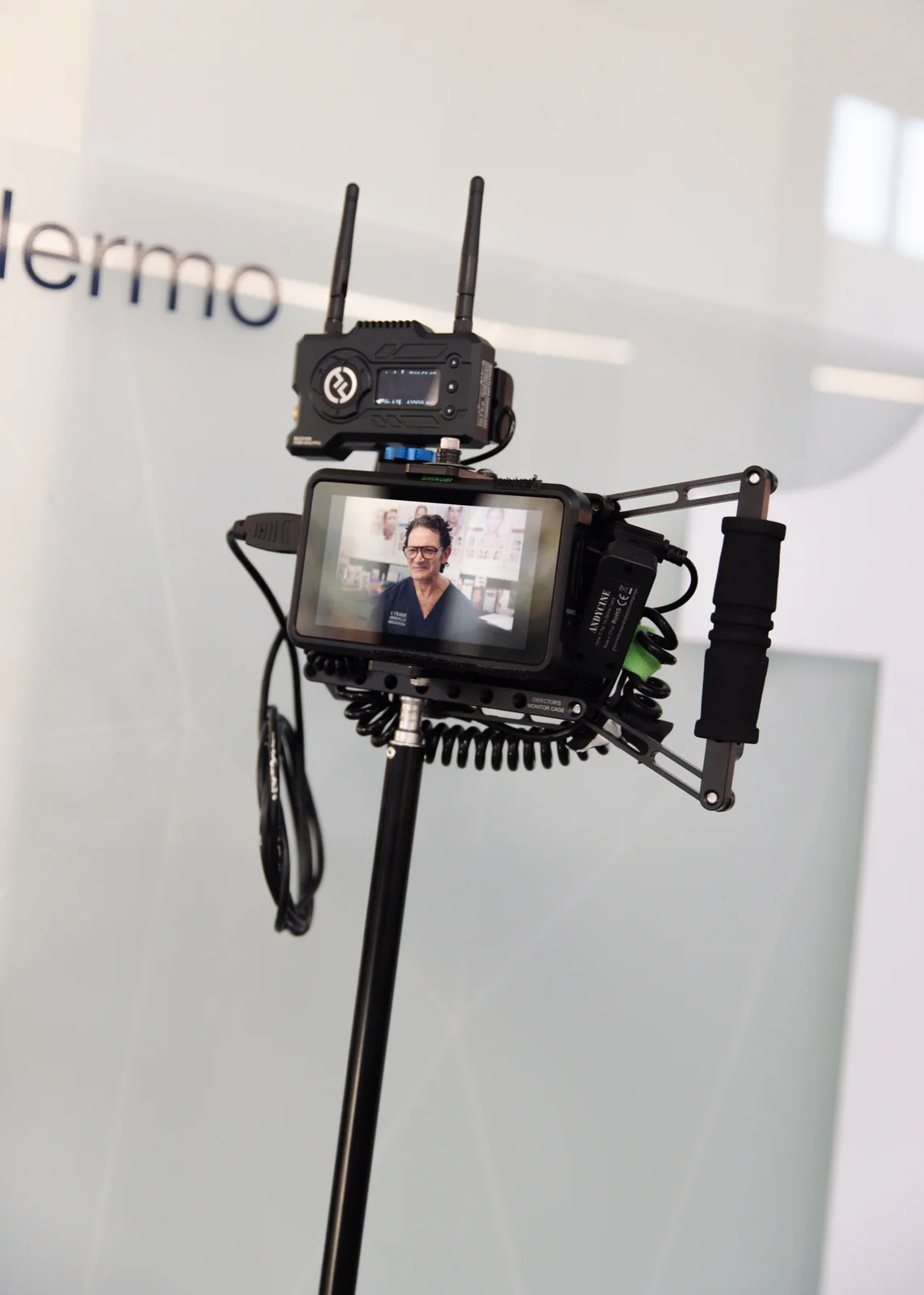
On the day, you’re not capturing 'content for next week.' You’re capturing source for the next four weeks. That changes how you shoot, what you light, and how the director runs the day.
Shoot wide and tight on every setup. A wide shot establishes context; a tight shot gives the editor punch. Same setup, two coverage passes, double the cuts. The cost of the second pass is minutes; the value across an editing month is hours of usable footage.
Shoot variations of the same hook. Same point made three different ways. The first take is rarely the best. The third is usually the keeper. Tell the talent up front so they don’t feel they’re failing the first take.
Shoot the photos at the same time. The lighting is already up. The talent is already in costume. The set is already dressed. If you’re not getting a photo suite from your video shoot, you’re paying twice for one day. A photographer running parallel to the video crew is the cheapest content multiplier in the business.
Shoot the B-roll your editor will need. Hands typing, the office space, product close-ups, the founder walking and thinking. B-roll is what turns a talking head into a story. Brief it explicitly, don’t hope it shows up.
Step 4: Edit and design for the platform, not the brief
The video that works in a 30-second TikTok ad isn’t the same video that works as a 90-second LinkedIn post or a 15-second Instagram Reel. Brief the editor for the cut, not the source. The same footage gets cut three ways, not used three ways.
Hook in the first 1.5 seconds. The hook is the entire reason a viewer keeps watching past the moment they realised they were watching an ad. Specific, surprising, and ideally pointed at a single objection. Generic openers are the fastest way to lose 70% of your audience before frame 30.
Subtitles default-on. Roughly 80% of social video on mobile plays muted. If your video doesn’t read silent, it doesn’t work. Burn captions or use platform-native auto-captions, but never ship without them.
Design templates that travel. Branded graphics, lower-thirds, end cards. Build them once, use them across every video for the next year. The visual consistency is what makes a brand recognisable in feed when the viewer is half-scrolling. This is where the branding work we do upstream pays off in the editing room.
Cut for completion, not for length. A 22-second video with 95% completion rate outperforms a 60-second video with 40% completion rate every time. The platforms reward people who keep eyeballs in the app.
Step 5: Distribute, measure, iterate
Posting is not the end of the content creation process. It’s the start of the feedback loop. Most teams treat distribution as a button-press; it’s actually where most of the brand-building happens.
Post on schedule, not on availability. The calendar runs the day, not the other way. If a post slips, your audience notices the gap before they notice the missing post. Use a scheduling tool, not human memory.
Reply within an hour for the first six hours. The platforms reward conversations. The comment that comes in at minute 30 and gets a reply at minute 45 is doing more for reach than the post itself. Brands that schedule but don’t reply look like brands. Brands that reply look like people.
Measure what posts won, not what posts you liked. Save rates and share rates are the truer signal than likes. On Instagram, sends-per-reach is the closest proxy to organic recommendation; on LinkedIn, dwell time and reshares matter more than reactions. Track them monthly and bias next month’s calendar toward the winning shapes.
Iterate the next cycle on what won. Most teams treat the calendar as a static plan. Treat it as a hypothesis. The best clients we work with rebuild around 30% of their calendar every month based on what landed the month before. That’s the loop. That’s the whole job.
What most teams get wrong about the content creation process
Three patterns kill most content programs.
Treating production as a one-off. A shoot every quarter that yields 80 pieces of content is not the same as a shoot every month that yields 25. The cadence of the shoot needs to match the cadence of the posting, otherwise you’re either burning footage or running dry. Cadence-matched production is the single biggest predictor of whether a content program lasts a year.
Scheduling without engaging. Brands that schedule but don’t reply look like brands. Brands that reply look like people. The replies are most of the work and most of the leverage. Hire for it, brief for it, measure it.
Pretty content with no hook. Aesthetic content with no message is the most expensive way to be ignored. Form follows function. The question is always: what is this single piece of content trying to do? If you can’t answer that in one sentence, the post isn’t ready.
Treating channels as identical. Instagram is image-led with strong save mechanics. TikTok rewards entertainment and rewatch. LinkedIn rewards opinion and dwell time. The content creation process needs platform-specific edits or it’s just shouting the same script into different rooms.
The team you actually need to run a content creation process
You don’t need a twelve-person content team. You need five roles, each of which can be part-time, fractional, or absorbed into one operator if budget is tight.
A strategist who picks the pillars and locks the brief. One person, part-time. The strategist owns the answer to "what is this piece of content for?" before the shoot is booked.
A producer who runs the shoot day and keeps the calendar. One person, full or fractional. The producer is the connective tissue between strategy, production, and distribution. Most content programs fail because there’s no producer.
An editor who cuts video, skilled enough to find the hook in the take. Usually a freelancer or a specialist brand video production agency. The editor’s job is to turn 25 raw clips into 25 ready-to-ship pieces, each cut for its target platform.
A designer for graphics and motion. Same arrangement. Templates first; bespoke designs second.
A community person who replies and reads the analytics. Often the producer, sometimes the founder for the first six months. The community role is where the brand voice gets practised in public, every day.
If you can’t justify five hires, that’s the case for an agency that runs the whole content creation stack on a fixed-fee retainer. The work is the same. The cost structure is fractional.
What working looks like in month three
Realistic targets after three months of running this content creation process.
Posting consistency hit at 95% or better. Whatever cadence you committed to, hitting it nine weeks out of ten is the baseline. Anything lower means the production system isn’t working yet.
Engagement rate steady or rising. On Instagram, 2 to 4% engagement is healthy for a B2B brand. On LinkedIn, 5% or higher is achievable on personal-brand-leaning content. The number matters less than the trajectory.
Save and share rates pulling ahead of likes. Saves and shares are the algorithm’s tell that content is genuinely useful. By month three the share-to-like ratio should be visibly better than month one.
First inbound leads attributed to content. Not every business converts on cold content; some need ads layered on top. But three months in, if no one is mentioning a post on a sales call, the message is wrong, not the cadence.
A library of platform-cut assets. By month three a brand running this process has 70 to 150 pieces of content shipped, plus a back-catalogue of B-roll, photos, and design source files to remix into ads, EDMs, decks, and the next campaign.
The loop, run for a year
Content marketing fails when production becomes the goal. The goal is the system. Lock the strategy, plan around the cadence, shoot for the four weeks ahead, edit for the platform, distribute and reply. Then iterate next month.
Run that loop for a year and you’ll have a brand that’s everywhere your audience already is. Most don’t. That’s the entire opportunity. The businesses we see grow fastest aren’t the ones with the biggest budget; they’re the ones who pick a cadence they can hold and hold it.
Frequently asked questions
- How long does it take to set up a content creation process?
- Two to three weeks from kickoff to first post going live, on a typical engagement. Strategy lock takes a week, the first shoot day sits in week two, and the first round of posts ship across weeks two and three. After that, the calendar runs every month on the same rhythm.
- How many posts a week do you need to make content marketing work?
- Three posts a week is the working minimum on a single channel. Five a week is where most B2B brands sit. Daily is a multi-channel commitment that needs two shoot days a month to feed it. Pick the cadence that matches your production volume; don’t pick the cadence that sounds impressive.
- How much content can you actually get from one shoot day?
- About 25 short-form video pieces, 10 photo posts, and 5 designed graphics from a typical half-day shoot. That’s 40 pieces of content total, which feeds three to five posts a week comfortably for one month, or three a week for a quarter if you’re on a slower cadence.
- Can a small business run this content creation process without an agency?
- Yes, if you have a producer who can run a calendar, a comfortable on-camera presence, and 8 to 10 hours a week to spend on edits and replies. Most founders don’t have those hours, which is why the work usually sits with an agency on retainer. The process is the same either way.
- What is the difference between a content creation process and a content strategy?
- Strategy answers what to say and to whom. Process answers how to ship it on a schedule. A brand needs both. Strategy without process produces a great deck and three posts. Process without strategy produces consistent content nobody cares about. The five steps in this article are the process; strategy is step one of the process.
- Which platform should we focus on first?
- Pick the platform where your audience already is and you can sustainably say something interesting every week. Instagram for visual and lifestyle brands; LinkedIn for considered B2B; TikTok if your audience is genuinely there. Owning one channel beats half-running four. Add a second channel only after you’ve hit consistent posting on the first for three months.
- How do you measure whether the content creation process is working?
- Three signals. Posting consistency at 95%+. Save rate and share rate trending up across the quarter. First inbound leads or sales conversations citing the content by month three. Likes and follower count are vanity numbers; the three above are the operating dashboard.
Work with us
Run this on a retainer
Productised content packages from $3,500 a month. Strategy locked, shoot run, edits shipped, posts scheduled, replies handled. Every week, every week.